Onwards now, we move to China’s spice capital of Sichuan, to discuss one of its ethnic minorities, the Nuosu, or Yi, and their prestige language. For clarity’s sake, this article will use Nuosu to refer to the language, and Yi for the people and broader language grouping.
(AN: I apologise for the delay in this article! They may be coming out a little less than once a week for the foreseeable.)
The basics

Nuosu is a Tibeto-Burman language spoken in parts of rural Sichuan, primarily in the Liangshan Yi Autonomous Prefecture, related to Burmese, the official language of Myanmar, as well as Tibetan (which deserves its own article in this series for its writing system alone). It is a prestige language (we’ll discuss what that means later) and is the official standardised form of the Yi languages. The language is written in Modern Yi (ꆈꌠꁱꂷ), a complex syllabary with hundreds of symbols representing every possible syllable in the language in each of the four possible tones. It is the largest syllabary to ever be standardised.
Nuosu is the only Yi language allowed to be taught in schools in China, due to the country’s language standardisation policies. It is, therefore, almost a form of “controlled resistance”, allowing ethnic minorities to maintain their own identity if, and only if, they conform to the standard set out by the government in Beijing. Even this controlled standard, however, has much internal diversity, with somewhere between four and six major dialects spoken by hundreds of thousands of people each.
Prestige and polyglossia
In linguistics, prestige refers to the social standing of a language within a community. For example, in Wales, English tends to be the prestige language, even in Welsh-language communities, due to underlying cultural attitudes towards the language. Nuosu holds a similar prestige position in Yi society—being the form allowed to be spoken in schools, the only form recognised by the government, grants a lot of social prestige to the language. Many Yi people will speak a different Yi language aside from Nuosu with family, but will use Nuosu outside of their own close community.
Referring to Nuosu as a prestige language comes with a huge asterisk, however, as it is still culturally subordinate to Mandarin. It is almost impossible to get into a university without flawless Mandarin, the only language the hyper-competitive Gaokao university entrance exam, as well as much of higher education beyond it, is available in.
Some speakers, therefore, can traverse all three layers of the polyglossic spectrum in one day—a low-prestige local language, such as Azha, with family, Yi outside of their community speaking to friends, and Mandarin at school or with the government. The choice to use one language or another signals belonging and performance of social expectations; speaking to family in Mandarin would be cold, and speaking to government officials in Azha could be nearly seen as absurd.
Mandarin, The Dominant

N509FZ (CC BY-SA 4.0)
Coming back to education, the Gaokao is the most important exam in China. Just saying those two syllables around a young Chinese person is usually enough to induce fear and anxiety. Its results are absolute, and one’s score in it dictates a huge deal about their options. If you want to get into a good university, to get a good career, to buy a house or flat in China’s real estate bubble, you need to do well in the Gaokao.
By extension, this makes Mandarin supremely important. Life outcomes hinge on a test available only in Putonghua (lit. “the common tongue”), ie., Mandarin. Children spend years of their childhoods revising for this one test, in Mandarin. Parents who can afford to will hire tutors to teach their children how to pass, in Mandarin. It builds a system whereby the only way to succeed is to know the national language, no matter what your local language may be.
This has social consequences—regional languages are often looked down upon or invalidated by the Mandarin-speaking public, especially young people, leading to an increased downwards pressure on their uptake and usage. If a child spends 8 hours a day learning, studying, and revising in Mandarin, and only learns how to communicate critically and express complicated ideas in Mandarin, a lower opinion of their “own” language is a natural outcome.
Controlled resistance
The Communist Party has a complicated relationship with minority languages. On the one hand, about 10% of the country’s population is not part of the Han ethnic group, and even among the Han there is much linguistic diversity (Hokkien, Cantonese, Shanghainese, etc.). On the other hand, the Party has built an image of “China as Mandarin”, still preferring Mandarin be referred to as Chinese in international spaces.
Linguistic diversity can be difficult for centralised regimes to cope with, as it almost universally creates an identity divide between speakers of different languages. The CCP’s response to this has been to allow some amount of linguistic diversity within the country, but within limits—standardised forms were selected and elevated (like Nuosu), or built as a neutral point between the language’s hubs (such as with Standard Zhuang in nearby Guangxi).
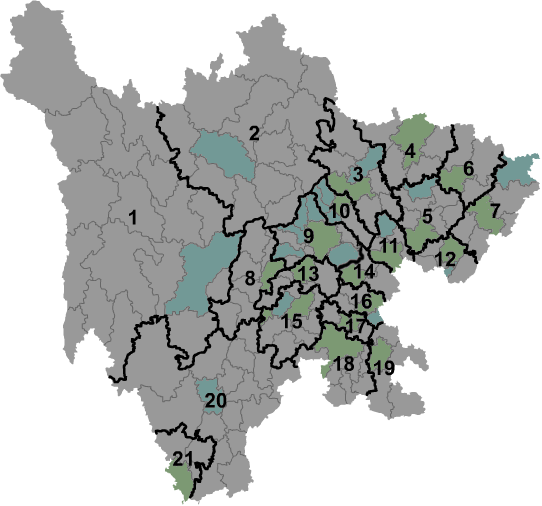
Nuosu was selected as the official Yi language largely because of its social prestige—before the Chinese Civil War, there already existed a large, educated, centralised population of Nuosu speakers in Sichuan, mostly in Liangshan. This made them a difficult political force to ignore when trying to establish CCP rule after Mao’s victory, granting them the right to continue using their own language. This came at the cost that the language must be standardised, with identity filtered through the state. The Nuosu language and Old Yi script were both strongly linked to local religion, and the writing system reforms broke that link, secularising the language and its education.
However, not all languages have received this treatment. The Han “dialects” lack official status for the most part, with their usage rapidly falling in the east of the country. The Chinese government in general refuses to recognise them as languages, despite being entirely mutually unintelligible and sometimes differing immensely in grammar and vocabulary.
Within the Yi family itself, there also exist many “unlucky” languages that get tagged as “dialects” and then discarded, for example, Azha, as mentioned earlier. These languages are also in steep decline as they receive no acknowledgement from the state and life shifts more and more into Nuosu or Mandarin.
Sinicising the non-Han populations and pressuring Han linguistic minorities to switch to Mandarin serves the same purpose of centralising identity. It ensures children are brought up into a world where Mandarin is the default in all affairs and their local language (if recognised) is subordinate.
Conclusion
Nuosu is a deeply interesting language. The geopolitics of China’s relationship to its linguistic minorities could be studied for a lifetime without ever really finding an easy narrative to tell—the state uplifts or expels languages in/from public life on what is often seen by outsiders as a whim, but the complex interactions between ethnicity, national identity, and language mean that every decision has its justification. I recommend reading more into this topic if you enjoyed this article.

Leave a Reply